7 questions to ask yourself before you start your yoga teacher training.

If you’re toying with the idea of teaching yoga, you’re in the right place. Here are 7 questions to ask yourself before you start your yoga teacher training.

You love yoga. In fact, you adore it. It has changed your life in so many ways and you want to share that joy with others. However… You’re a little bit scared. You aren’t sure whether you’re ready to make that hefty yoga teacher training commitment.

I hear you! It’s a massive decision. And there’s so much to consider before taking the plunge. Not only do you need to choose the right yoga teacher training course for you, but you also need to figure out whether or not you are actually ready for this next phase of your yoga journey.  

While I am (of course) the biggest advocate for yoga teacher training, I strongly believe that students should approach their decision with an inquisitive mind and plenty of questions – both for themselves and the training school.

So, to help you on your way, I’ve pulled together 7 of the key questions you should ask yourself before you start your yoga teacher training.

MORE INFORMATION

RELATED: SHOULD I GET MY 200 HOUR YOGA TEACHER TRAINING?

1. Why do you want to do yoga teacher training?

Start at the beginning – why do you want to do yoga teacher training? 

This may feel like an obvious one, but I cannot underestimate its importance. Your reason needs to be true to you. I have seen people come through teacher training because they were told that they were ‘good’ at yoga and should therefore become a teacher. Or because they liked yoga and therefore thought a teacher training would be like an extended retreat. 

Look – I am not saying these reasons are wrong (except YTT is definitely NOT an extended retreat!). I’m saying they won’t get you through the intensity and challenges that come with a yoga teacher training.

Your ‘why’ will keep you going through the good times and the bad. It’s the ‘thing’ you will refer back to in those moments where you rue the day you signed up to a teacher training (no exaggeration!). Before you commit, be sure that you are fully aware of your why – and that it’s powerful enough to push you on.

2. Is your physical body ready for yoga teacher training?

While a big portion of your teacher training will be spent off the mat, it is still an incredibly physically demanding experience. Your body needs to be ready for it.

As yogis, we all know how much of an empowering practice yoga can be. It is one that promotes strength and stability and can work wonders for our physical health. Yet, if you are nursing long-term injuries or have avoided physical maintenance for a sustained period of time, now may not be the time for you to do your training.

Saying that, completing yoga teacher training with a physical ailment can offer an amazing opportunity to practice humility and compassion for your physical body, as well as your future students. As I write this blog, I currently have two yogis on my 200 hour teacher training course with injuries. While I am sure they would prefer not to be injured, they have both learnt a huge deal about adjusting their practice and showing themselves true loving kindness throughout their healing.

3. Are you emotionally and mentally ready for yoga teacher training?

Yoga teacher training peels back the layers – every single one of them. It is an emotionally demanding and yet utterly illuminating journey. Mentally, there is a lot that you need to be ready for.

You will be forced to look inwards. And I mean really, really inwards. You will learn and relearn things about yourself and the world around you that you thought you had already figured out. You will be critiqued and put on a stage for others to witness and comment on. You will be challenged and you will cry – a lot!

Before you run 100 miles in the other direction, these responses do not have to be seen as negative. Far from it. Emotionally and mentally, yoga teacher training can be transformative. A past student once said to me ‘it was either yoga teacher training or therapy’. If you are prepared – and ready – then it will be an experience like no other.

4. What is your financial situation?

The elephant in the room – finances. The simple truth is that yoga teacher training does not come cheap. Yes, it’s an investment in your future. But it’s still an investment that you need to be financially secure enough to make.

Many yoga teacher training schools will offer payment plans. This can be a great way to make the training more accessible to you, so check in whether or not this is an option. If you sign up earlier, you can often get an early bird discount.

However, if the only way that you can pay for your yoga teacher training is through loans, credit cards or taking on additional work which you are not energetically available for, please think long and hard about whether this is the appropriate time to make such a large financial commitment.

5. How long have you been practising yoga?

Most yoga teacher training schools will ask you this question on your application. It isn’t just something they ask you for the sake of it. It’s crucial that you have a long and consistent history with yoga – both on and off the mat.

Why? Because yoga teacher training is HARD. And although you are absolutely not expected to know everything when you enrol (you will never know everything!), you need to have a personal and deep connection with yoga so that you can absorb your new learnings. 

6. Are you happy with the course curriculum?

Take a look at the course curriculum – does it cover everything that you need for your teaching foundations? 

This is both a personal perspective and a yoga standard one. A high quality yoga teacher training should include elements of:

  • Asana and lesson planning
  • Meditation
  • Anatomy
  • Variety of yoga styles
  • Teaching methodology
  • Culture and yoga roots
  • Yoga philosophy
  • Business methodology and marketing
  • Pranayama and energy practices

Then ask yourself what kind of yoga teacher you want to be. This is a MASSIVE question. It covers everything from the yoga discipline that you want to teach (for example there is little use going to an Ashtanga based teacher training if you want to teach Vinyasa Flow), your own values (such as cultural sensitivity), who you want to eventually teach (and whether the course teaches and promotes accessibility) and how much all of the different topics are weighted.

The teaching school should provide a syllabus for you to look at before making a decision, as well as any reading lists (a great way to get a flavour for the overall programme).

7. What do you hope will happen once you finish your yoga teacher training?

If you are doing your yoga teacher training to be a teacher (and not everyone does it for that reason!) then it’s worth looking at how much practical teaching experience the training school provides.

I cannot count the number of teachers who have told me stories of when they finished their teacher training and felt absolutely terrified to teach a real-life class. Many even went on to re-do their 200 hour training because they simply did not feel equipped. This is why it is so vital that you choose a school that will prepare you for wherever you want to take your yoga practice.

At the Laura Green Yoga Teacher Training School, we run community classes every Sunday of training weekends. By the end of our 9 month programme, students will have taught the public a minimum of 8 times, as well as their final teaching exams.

Alternatively, if teaching isn’t a priority for you and you are searching for a more philosophical journey, then seek out a school that caters for your needs. The beauty of yoga training is that the options out there are endless. Don’t rush into a decision. The answer will come.

YOU MIGHT LIKE: 10 THINGS TO KNOW BEFORE YOGA TEACHER TRAINING

Apply for the Laura Green Teacher Training School 200 hour Teacher Training in 2023.

Join me and my 2023 cohort of passionate yogis at my next 200 hour teacher training programme. I promise you love, laughter and LOTS of soulful inquiry.

Still not sure? Watch my yoga teacher training introduction video and please do feel free to reach out and ask me ANY questions. 


Facebook

How to choose the right yoga teacher training for you.

You’re interested in completing your 200hr yoga teacher training, but you aren’t sure where to start? Read my guide on how to choose the right yoga teacher training for YOU.

So, you’ve decided that you want to do your 200-hour yoga teacher training – amazing! That is all kinds of exciting. But, there’s one thing getting in the way: you aren’t sure how to choose the right yoga teacher training for you.

This is something I get asked about A LOT. With endless options out there, I totally get why choosing your yoga teacher training can feel like a bit of a minefield.

Luckily, there are some (important!) questions you can ask yourself to start figuring out the right yoga teacher training route for you. Let’s break it down; maybe these questions will provide you with some clarity!

You might like: 8 signs you’re ready for yoga teacher training 

And: Should I get my 200 hour yoga teacher training?

1. Who are the instructors on the yoga teacher training?

First thing’s first – who will be teaching you? It might sound obvious, but you really need to work well with them. After all, you’ll be spending at least 200 hours in their company! 

Ideally, you’ll have practised with the teacher before, or at least have a strong awareness of their lineage and teaching style. Some teacher training will bring in additional teachers to truly enrich your learning, so this is something that’s worth checking in on. For example, the Laura Green Teacher Training Yoga School 200-hour teacher training has specific teachers for anatomy, meditation, mental health, and marketing alongside the overall bulk of the course.

If you don’t know the instructor (or know someone who can vouch for them), check:

  • How long have they been teaching?
  • How long have they been training teachers?
  • What is their teaching style?
  • Where did they do their training (and how many different ones have they done)?

And before you make a decision – have a chat with them! Teachers should offer initial conversations with potential students. This is a great way to see whether you feel comfortable with them and excited by the idea of studying with them.

2. Will you do your yoga teacher training home or away?

This is a big one – will you do your yoga teacher training at home or abroad?

There are many elements that come into this decision. Some long for adventure and travel, so the prospect of escaping the everyday in an overseas training is incredibly appealing. For others, commitments at home mean that they can’t take a month ‘off’ for a yoga teacher training in another country. Likewise, taking your training abroad can mean that those deep connections you gain on your course won’t actually necessarily live in the same country as you. This doesn’t have to be a problem, but if you are hoping to build life-long relationships on your YTT (which you absolutely can and will) then it’s going to be a bit trickier if you aren’t studying in your home country.

Plus, you need to take into account your personal learning style (something I’ll dig into in the next point). An ‘away’ YTT is typically immersive, meaning you’ll be learning every single day until you reach your 200 hours. If this doesn’t suit you, then it might be worth looking closer to home.

3. Do you want an intensive or long-term YTT?

All yoga teacher training delivers their hours in a different way. If you need to learn free from distractions and in a fully immersive environment, then you may want to opt for an intensive YTT – this is most commonly spread over the period of 30 days.

Alternatively, long-term YTTs mean that you can naturally embed your studies into your everyday life (and vice versa). They come in many different forms. I’ve seen training spread over three months (with a mixture of long weekend and week intensives), 18 month flexible programmes, 12 weeks part-time and everything in between. Here at Laura Green Teacher Training Yoga School, our 200-hour YTT runs across 9 months with one weekend per month and a week long intensive to close the training.

Ultimately, it’s about finding what works for your lifestyle and learning.

4. What’s your learning style?

This is when you need to start drilling down into what you want out of your yoga teacher training.

If you are a hands-on learner, then it’s likely that a fully online YTT won’t support your needs. Likewise, if you are a visual learner, you want to look for training that has options catering to this; for example, video lectures, practical demonstrations etc. Or if you learn by doing, you want to check that your YTT has plentiful opportunities to teach, practice hands on assists, lead meditations and work through anatomy assessments in person.

It’s a lot to consider – I know. But, by speaking to the course leader, you can quickly determine whether the programme will help you to flourish and reach your training goals.

5. What are you interested in?

If yoga philosophy is the beating heart of your yoga practice, yet your YTT covers next to nothing on it – well, you don’t need me to tell you that probably isn’t the training for you!

Certain schools will specialise in particular areas, so if there is one you feel really passionately about, make sure that your YTT has a syllabus that represents that. In addition, if you know you want to be a vinyasa teacher but this school only teaches Ashtanga, you’ll likely end the course feeling unfulfilled and in need of additional training.

6. Is the syllabus varied?

Off the back of this, while it’s crucial that the yoga teacher training covers areas you love, it’s also important that it covers areas you are lacking.

A high quality yoga teacher training syllabus should include:

  • Asana and lesson planning
  • Meditation
  • Anatomy
  • Variety of yoga styles
  • Teaching methodology
  • Culture and yoga roots
  • Yoga philosophy
  • Business methodology and marketing
  • Pranayama and energy practices

Even if you shudder at the idea of one of these topics, they are ALL vital parts of being a yoga teacher – your teacher training needs to deliver them.

7. Is the yoga teacher training certified?

Is the yoga teacher training school accredited? If yes, who by? Look into the standards set by that accreditation and whether this contributes to your confidence in the course.

The Laura Green Teacher Training Yoga School is accredited by the Independent Yoga Network. I chose this network as it aligns with my values as a yoga teacher and teachers have to follow a stringent process in order to be accepted within the network.  

You can find out more about IYN here.

8. What is expected of you?

Are you emotionally, physically and mentally ready for what the yoga teacher training programme requires of you?

There are certain elements that are fairly consistent across most schools, but there will also be huge differences in expectations. You need to be sure that you are ready for them. For example, will you be asked to do homework in between sessions? Do you have time for that? Will you be required to teach outside of your class? Will you need to maintain a certain level of yoga practice?

Ask the questions and process the answers in the context of your life – right here, right now. YTT is an enormous commitment, whatever way you look at it. Find a training school where you can fulfill what is needed of you.

9. Can you speak to past students?

One of the best ways to find out whether something is the right yoga teacher training for you is to talk to people who’ve actually done it!

An honest, open conversation will tell you far more about the training than any piece of marketing material can. What did they like about it? What did they find challenging? Would they recommend it? Why?

Gain as much information as you can before making that big, life changing decision. You won’t regret it.

You might like: 10 things to know before yoga teacher training.

Apply for the Laura Green Teacher Training Yoga School.

You can now apply for the 2023 Laura Green Teacher Training Yoga School 200-hour programme.

Learn how to become a professional, confident, and passionate yoga teacher with our 200 YTT 9-month training course. Find out more and apply for a place here. I can’t wait to hear from you.

Laura x


Facebook

8 signs you’re ready for yoga teacher training.

Toying with the idea of yoga teacher training? You’re in the right place. Read on for the eight signs that you’re ready for yoga teacher training.

If you love yoga, there’s a strong chance that you have considered yoga teacher training at one point or another. It feels like a natural progression. An exciting way to take your yoga practice to the next level. 

But – yoga teacher training is a substantial commitment. You need to make sure it is the right choice for you.

Yoga teacher training goes far beyond the physical practice. You may learn about the history of yoga, anatomy and meditation. You may cover culture, sanskrit and mantra. Some schools will explore business and marketing, others will take a deep dive into the different styles of yoga.

It’s exciting, fulfilling and illuminating. 

So, how do you know that you’re ready for a yoga teacher training course? Here are 8 signs that – I believe – show that yoga teacher training could be a brilliant step in your student journey.

RELATED: 10 THINGS TO KNOW BEFORE YOGA TEACHER TRAINING

1. You’re craving more.

e of the biggest draws towards yoga teacher training is the need for more.

More connection. More challenges. More inner work. And, of course, more yoga!

The great thing about yoga teacher training is that it goes far beyond anything that you can capture in a 60-minute class. Depending on the route you take, it’s 200 hours of intense and hands-on study which you will apply both on and off the mat.

If your current practice feels like it’s only scratching the surface, this could be just the thing.

2. You want to go on a deep inner journey.

Yoga teacher training is about so much more than what you can share with your future students: it’s about what you can learn about yourself.

Because yoga teacher training peels back the layers. It’s some serious stuff! You will learn SO much about yourself, far beyond the context of yoga alone. Sometimes that will be beautiful and other times it will be challenging. But it will be incredibly worth it. I can confidently say that every single one of my students has come out of their yoga teacher training different in some way. Be that a shift in perspective, a surge in their confidence or a full blown inner transformation. It’s exceptional to witness.

3. You want to share your love of yoga with others.

Has yoga changed your life? Are you being called to share that journey with others?

Yoga teachers have a very, very special role in this world: we get to bring people together through yoga. We get to gift this magical practice and see firsthand the impact it has on our students’ lives. How amazing is that?

If you feel the desire to share your passion for others, then you already have what it takes inside of you to be a brilliant teacher. You have the seed; now you need to water and nourish it so that it can fully bloom.

4. You aren’t sure whether you want to actually teach.

Likewise, if you aren’t sure whether you actually want to teach, that’s great as well. Not everyone who does yoga teacher training wants to be a teacher. Some will never teach a class in their entire life.

I’m going to use the ‘J’ word again, but this really is a journey. You will learn throughout your training what you want to do with it. If you approach it with an open mind, the answer will come.

5. You love learning.

Love to learn? Brilliant – because you will learn A LOT during your yoga teacher training.

Every school approaches their teacher training differently, but as a minimum, you will learn about the physical asana, the art of meditation, and anatomy. Comprehensive schools will also guide you through the history and philosophy of yoga, the precision of sanskrit, the power of language within your teaching, the art of sequencing, business and marketing opportunities and safe and mindful assists. And there’s so much more that you could go into. 

If you have a thirst for knowledge, then yoga teacher training will definitely quench it.

6. You aren’t afraid of hard work.

I’ve said it before and I’ll say it again – yoga teacher training is hard. It isn’t supposed to be easy. It will challenge you and you will have huge wobbles. But, if you know that and you’re okay with it then you will embrace it… Every single part of it.

Be prepared to be vulnerable, present and committed. This will give you the mindset you need to flourish.

7. You’re waiting for that lightbulb moment.

Are you unsure about where your path is taking you? Are you curious about how you could take your yoga practice and unpack it into different areas of your life?

Yoga teacher training is a brilliant means of shining a light on the road ahead. I can’t count the number of times I have had a lightbulb moment during my yoga or meditation practice. Now, picture that state of mind but intensified!  

Your yoga teacher training may not provide all the answers, but it will absolutely guide you through the questions.

RELATED: SHOULD I GET MY 200 HOUR YOGA TEACHER TRAINING QUALIFICATION?

8. You’re searching for your yoga family. 

Perhaps the most underestimated part of yoga teacher training: your yoga family.

Your fellow course students will become so special to you. They’ll see every part of you – the good, the bad, and the ugly! It’s impossible to go through all of that together and not come out with an unbreakable bond.

You will go through your training with such a feeling of connection; this feeling won’t disappear once you have your certificate. It will stay with you for life. As a teacher, I adore seeing past students of my teacher training on their monthly meetups, attending classes together, and truly being friends for life.

Can I do my yoga teacher training with Laura Green Yoga?

Absolutely – and I would love to have you there.

My next 200-hour yoga teacher training course starts March 2023, and you can find out more and apply here.

I also offer a range of other teacher training courses which you can read more about here.

Laura X


Facebook

Step by Step Guide to Sell Out Your Yoga Retreats & Yoga Workshops

Do you dream of running yoga retreats and hosting yoga workshops? Would you LOVE sold-out events with students you adore teaching?

Hosting yoga events for your students is a wonderful way to grow and expand as a Yoga Teacher and great opportunity for your students to explore more the teachings of yoga.  

So, what is the secret to sold-out yoga retreats and waitlisted yoga workshops?

Is it finding the perfect venue? Collaborating with other teachers? Listing your yoga events on retreat websites?

Nope. It’s simply having a strategy you can follow to communicate what your event is, who it’s for and how someone will benefit from attending it. Then implementing this strategy with another lead time.

Here is my tried and tested 7 step road map to selling out your yoga retreats and workshops. I have followed my method for over a decade selling out over 400 yoga workshops and retreats in the UK and worldwide! If you fancy joining me on retreat – see the yoga retreat calendar here.

Download your FREE Roadmap to Sold Out Yoga Events & Retreats

If you are ready to tap into the power of your teaching and draw more students to your yoga retreats and courses, I encourage you to take this roadmap I am about to share with you and put it into practice straight away. If you want 1:1  help check out my private yoga teacher coaching calls here.

Want to know what will consistently draw students to your offerings and leave you with sold out events?

Create something that your ideal student will love, need and rave about!

We as teachers can often develop a retreat or course that we want to create, rather than considering if it is a good fit for our yoga students. Yes, our ideas might be innovative and exciting for us, but it may not be what your students need.

Often what our students need is a lot less than we anticipate. Remember you have hundreds of hours of yoga teacher training under your belt. Your students do not. You don’t necessarily need to deliver all the bells and whistles, you just need to create something that addresses what your students are most interested in learning about.

Your students can’t wait to hear about your retreats and courses, so put the fear to one side and start here!


Facebook

How to Create Your Own Chair Yoga Sequence

If you’re reading this then you have been thinking about teaching Chair Yoga in your local community. Sequencing for a chair yoga class is not that much different from a normal yoga class.

Just like crafting any yoga class, your chair classes are a journey you guide your students on. Students arrive in the midst of life and enter the sanctuary of yoga, a warm embrace of mindful movement, where transformation occurs.                      

Applying the fundamentals of any yoga class you would start with basic body and breath awareness. Allow that to flow to small movements and then gradually expand the parameters of movement until the whole body is involved.

Why Chair Yoga?

Chair yoga works great for this because we start in a seated position that is accessible to a vast majority of students and requires little energetic expenditure. Once the students have focused on the body and breath, we can take the practice wherever we want it to go, choosing the level of intensity that is appropriate for the group or the individual student.

A simple lesson plan formula

This is a simple method for a well-rounded class that can be followed for a 30 min – 60 min class duration.

•          Centre & Connect: Begin in stillness and connect to the breath and the body

•          Warm-Up: Gentle mobilisation for the major joints, and move the spine in all directions

•          Build Strength: Simple exercises for core, arms, shoulders, upper back, quads & glutes

•          Power Poses: The equivalent to standing flows, with warriors, lunges, triangle, etc, can be adapted to stay seated or build to standing variations with the chair or wall for support.

•          Balances: Include in all classes, where possible, using the chair or wall for support

•          Find Flexibility: Add plenty of lovely stretches which release tension and endorphins.

•          Soothe: Gentle poses preparing for savasana, either seated in the chair or for those able supine poses; I love to revisit some of the warm-up asanas so the students can notice the changes in the body from class

•          Rest & Restore: Finding a comfortable, restful position for savasana

Develop Your Knowledge

I hope you feel inspired to share this special practice with your community – adding another level of skill and sharing yoga that is accessible for all. My new book titled “Teaching Chair Yoga”  is a practical guide that will deepen your knowledge, support, and inspire you to share the teachings of Chair yoga safely and effectively. Not only do you receive 10 ready-to-go lesson plans, but this book is the equivalent to a 5-day CPD course!


Facebook

Why every yoga teacher should know a little chair yoga?

teaching chair yoga

You’ve seen just how your yoga classes positively impact your students. However, beyond your usual vinyasa flow class lies an entire population that are in need of your service too.

A niche client base

Yoga continues to grow in popularity and as more people connect with yoga there are more teachers offering the same style of yoga to the same students. To stand out as a Yoga Teacher and attract enough students for a sustainable and rewarding teacher career, it is essential to have 1-3 niches or ‘ideal student’ groups that your classes, branding and marketing focus on.

Often a students first impression of yoga is often that you need to be fit and flexible to do yoga and as yoga teachers, we feel that “Yoga is for everyone”, if you live by that mantra I think you will love teaching Chair Yoga and at the same time you are broadening your audience.

Chair Yoga Embodies “Yoga is for Everyone”

Chair yoga is yoga that is practised primarily whilst seated in a chair and is widely recognised for its accessibility. Traditional yoga asana, such as sun salutations, standing, seated, and reclined poses, can all be adapted for chair yoga. It is also excellent for joint mobility work and a gentle way to improve overall physical posture. 

Chair yoga was originally popularised for older people, people who experience limited mobility, are physically disabled, and neurodiverse populations who benefit from the support, movements, and sequencing unique to chair yoga.

Build a community

This is a very rewarding demographic to teach. As people progress through later stages of life, inactivity, loneliness, lack of community engagement can be challenging and detrimental to health.

Often, a person’s weekly Chair Yoga class can become the focal point of their week, as a chance to get out, to do something different, to exercise their body and mind and connect with like-minded souls. This makes for loyal and committed students and a very rewarding experience for all.

As Teachers of Yoga, our job is to make the wonders of Yoga accessible to all. When you first qualified, you wanted to change the world! Ignite that flame and share your knowledge with a population waiting to hear from you!

Develop your knowledge

If you feel inspired now to add Chair Yoga to your Yoga Teacher skills then my new book “Teaching Chair Yoga” will support and inspire you to share the teachings of yoga safely and effectively with this growing population.

This book is equivalent to a 5 day CPD course and will give you all the confidence you need to share Chair Yoga within your community.


Facebook

How to Avoid Burnout when Growing your Yoga Business

Being a Yoga Teacher and building your yoga business is more work than many of us at first realise. From marketing your yoga classes, liaising with your students, planning classes and doing your accounts there’s a lot to do and it’s easy to feel overwhelmed or burn out. But the good news is with a few mindset shifts, a sprinkling of productivity tools and some self-discipline you can build your yoga business with ease, flow and grace.

1) Slow down to go further.

Building your yoga business is a marathon, not a sprint and you want to be in this for the long term. So slow down to go further you don’t have to achieve everything immediately. If a sprinter approached a marathon at their usual pace they would soon burn out and not complete the run; they know they have to slow down to go further.

2) Be project based.

You can’t work on building all your classes and yoga offerings at the same time. So think about the different aspects of your yoga business as individual projects. If you teach more than one class, don’t focus on filling them all up at the same time. Pick one class to focus on and then when the numbers improve refocus on the next project.

3) Be tasked based.

There are so many different types of activities when growing your business and it’s easy to flit from task to task but this creates the feeling of overwhelm and reduces productivity. Group similar tasks together and only do one thing at a time. For instance, set aside a limited time each day to respond to emails, then move on to the next task such as writing a newsletter, try not to dip in and out of different tasks.

4) Have an ideas book.

Yoga teachers are often very creative and ideas come to use freely. This can lead to starting lots of new projects but not seeing them through. When you get a new idea it doesn’t have to be actioned immediately, remember we’re being project-based. So keep an ideas book, note everything down and when you have completed a project and honestly have space to take on something new return to your ideas book and see what is still resonating with you.

5) Reuse, & repurpose

Look back at the yoga courses, workshops, classes you have delivered previously and repeat them! Reuse your lesson plans, playlists, course materials and marketing. You will have new students who want to do this offer, students who didn’t do it before and students who would gladly repeat it! You don’t always have to start afresh!

6) Pre-book time off in your diary

If you leave blank space in your diary it is easy to fill it up! Pre-book weekends off, days off, weeks off in your diary for the whole year. Make this non-negotiable time!


Facebook

10 Day Christmas Dash – Quick Wins for Your Yoga Business

Yoga Business Resources

December slow down? It’s time to spruce up your yoga business before we get started planning for your best year yet as a Yoga Teacher in 2022.

This FREE 10 day business clean up starts on Monday 6th Dec, download your free resources today!

Download FREE Canva Templates for Your Yoga Business

We have 10 days to get through 10 stocking fillers, each is a 5 mins or less quick win for your yoga business.

Over the 10 days we’ll be cleaning up your yoga business before the New Year Rush. Complete each days task and tag my on Facebook or Instagram, we start Monday 6th Dec.

Day 1: Update your linktree

Day 2: Update your facebook page covers

Day 3: Update your Instagram highlights

Day 4: Share a social media post or email inviting students to purchase a gift voucher for Christmas

Day 5: Get one new google review

Day 6: Do a mini audit of your website, check all dates and events are accurate

Day 7: Update your Google Business Listing

Day 8: Send a thank you email and social media post

Day 9: Filter your stripe account my customers, and spend. Then send a Christmas present to your most loyal students

Day 10: Give our Christmas Cards at class with a ‘What’s On in 2022’ paper insert.

Free Canva Templates for Yoga Teachers

To help you take action I’m sharing with you my Canva Templates saving you both time and money AND for every 2 activities you complete in the Christmas Dash there’s an opportunity to WIN a one:one Social Media or Website Review with me, Laura Green, inside of The Yoga Teacher Collaborative Group  complete the following steps:

RELATED: Enroll in my 4-day FREE Business Summit for Yoga Teachers to Thrive in 2022

Join the Christmas Dash for a Chance to Win:

For a chance to WIN a one:one Social Media or Website Review with me, Laura Green

  1. Join the Christmas Dash – head over to Instagram and announce you’re joining the Christmas Dash, maybe invite some of your fellow Yoga Teachers to join you as accountability buddies! Tag @lauragreeyoga so I can cheer you on!
  2. For every two activities you tick off from the 10-day Dash you get 1 entry into the prize draw. The more you tick off the more chance to win!
  3. Share and Tag Me @lauragreenyoga each time you tick 2 things off
  4. The winner will be announced Wednesday 15th December

Download FREE Canva Templates for Your Yoga Business


Facebook

10 things to know before Yoga Teacher Training

So, you’re thinking of doing your yoga teacher training? Fantastic! It really is one of the most fulfilling experiences you can take part in. But, there are certain things you should know before you make that wonderfully exciting decision.

Yoga teacher training is about much more than increasing your yoga classes and getting a nifty certificate. It’s an enormous commitment; one that requires a lot of heart, determination and resilience. If you’re seriously considering turning your passion from yoga into a career, read on for my ten top things to keep in mind before starting your YTT.

1. You can’t escape it – studying is paramount.

If you avoid studying like the plague, then the reality is that yoga teacher training probably isn’t for you. Yes, there’s a lot of studying inside of the classroom/studio, but you also need to put the hours in outside of your actual ‘school hours’.

This matters because not only is it necessary to pass your course, but you also need to have the knowledge around what is needed of you once you step out into the real world as a teacher. Injuries can easily happen during a class, and unless you understand the risks and how to avoid them you may find yourself in a tricky situation. 
Your students are putting their trust in you every time they roll out their yoga mat. Get ready to put the time and effort in to rack up those genuine study hours.

2. Be prepared for hard work.

Yoga teacher training is no walk in the park. A YTT is hard. Really, really hard. It’s physically, mentally and emotionally demanding and it will seriously put you through your paces.

If this is something you are prepared for, then fantastic: the satisfaction that you’ll gain whenever you conquer a new part of the training is like no other. And afterall, nothing worth having ever did come easy, did it?

3. And a midway wobble.

Almost all of my yoga teacher students hit a wobble part way through their YTT. They’ll convince themselves it’s too difficult and that they can’t do it. The tears tumble, the smiles disappear and everyone has a bit of a rant. 

Believe me; this is totally normal! I’ve seen it before and I’ll see it again. But don’t worry. If this does happen while you’re on your yoga teacher training, your fellow students and teachers will be there to lift you back up again. It’s what they’re there for.

4. It will be emotional.

We’ve covered the wobbles, but there are SO many more other emotions that come with yoga teacher training. Highs, lows and everything in between. 

It isn’t just the sheer enormity of what you’re doing – it’s the impact it has on you as a person. You may find that during your YTT you uncover feelings that you didn’t even realise were there. Lean into them. There’s a power in allowing yourself to be vulnerable.

5. Self care is crucial.

Because of this, you really need to make sure that you are ready to give yourself some extra TLC during your yoga teacher training. 
Your body will hurt. It will ache. And there will be bruises. Plus, you’ll be tired: both your body and mind. Be sure to factor in additional time for self care. You’re going to need it.

6. Know your intention (and be ready to change it).

Before you sign up for yoga teacher training, ask yourself why you want to do it. What’s your intention for the course? Is it to start up a yoga business? To deepen your own practice? To move abroad and take your mat on the road?
It’s important to know that you’re doing your yoga teacher training for the right reasons… And to be aware that this intention may well change once you start doing your training!

7. Put yourself first and foremost.

Even if your intention is to build a thriving yoga business, if you want to get the most out of your yoga teacher training you should put yourself at the center of it. That means knowing and appreciating that your growth as a human being is far more important than getting your name onto the Yoga Alliance directory ASAP.

The best way to do this is by applying everything you learn during the course to your everyday life. Do this and you’ll be astounded by the amount you develop and change.

8. You will gain SO much beyond your qualification.

Of course your yoga teacher training qualification is gold dust, but it’s safe to say that it’s just the cherry on top of the cake.

You’ll embrace the beauty that can be found behind the asanas, as well as learning to be your own teacher. You’ll also (re)connect with your inner self and uncover ways to express yourself in unique and creative ways. These skills will support you both on and off the mat; it truly is such a gift.

9. You’ll make friends for life.

Your fellow students will become your support network. They’ll see so many different sides of you and will be with you, every step of the way.

They’ll be your cheerleaders. Your friends. Your yogi family. These relationships are special and everlasting.

10. It’s the experience of a lifetime.

There’s no denying it: yoga teacher training is an experience of a lifetime. It’s a spiritual, transformational and enchanting journey – one that will change you as a person and totally rewrite your path, whatever your intention for the course.

It’s the ultimate benefit of taking part in yoga teacher training. It’s an investment in the life you dream of, teaching the thing you adore. And what could be better than that?

Are you ready to take the next step in your yoga practice and teaching journey? Register your interest in my 200-hour yoga teacher training course or read my blog ‘Curious about yoga teacher training? Let’s explore!’


Facebook

New Yoga Teacher? This is what you need to know

New Yoga Teacher? This is what you need to know

Would you like to be a full-time self-employed Yoga Teacher?

Well, this is what you need to know . . .

The role of a yoga teacher is 30% actual yoga teaching and 70% working on your yoga business.

Go in with your eyes wide open to this fact, learn a lot more about how to run a yoga business and you’ve got the BEST full-time job there is!

So what makes up the 70%?

Marketing

Building relationships with potential students, finding out about their day to day challenges so you can make qualified and personal invitations to try yoga. Start here with Social Media for Yoga Teachers training video.

Sales

Making that invitation, telling people about your classes, sharing posters, flyers and more. Learn more with my Guide on 60+way to Attract new Students.

Customer Service

One to one communication via email, text, social with students and potential students, email newsletter and nurturing. Sending thank you emails, confirmations and follow-ups from events, answering any and all messages, comments and questions at class. Need help on this point – here’s a 20 min training on how to cherish your students with good customer service.

IT

Working on your website, creating landing pages, updating your booking sites, keeping up with your google my business, using a blog to improve your SEO, building your email list.

Lesson Planning

Crafting wonderful yoga journies that keep your students coming back each week. Try theming your yoga classes with more in-depth journeys – here’s my guide on How To Theme a Yoga Class.

Project Management

Booking, planning, orchestrating events such as retreats, workshops. Liaising with venues, caterers and collaborators💡 Ongoing Learning – getting to classes and workshops with other teachers, watching trainings on business, reading and networking with other teachers. Try a 3 month’s strategic business review, with this Yoga Business Plan guide.

Finance

Sending out invoices, paying supplies, booking, and creating a month profit and loss.

AND MORE!

Ready for this? Cause I’m ready to help you.

Make sure you’re a member of the Yoga Teacher Collaborative UK – a free community with weekly trainings on all this and more!

Book a coaching call with Laura

I offer 1:1 90 min laser-focused coaching sessions for Yoga Teachers, you can learn more here.


Facebook

Social Media for Yoga Teachers: Supercharge Your Online Presence

Social Media for Yoga Teachers

Are you fed up with trying to market your yoga classes online and not seeing any results? It’s so easy to spend time posting and scrolling on social media thinking that you’re marketing your yoga classes without actually seeing any results. Yet a few simple tweaks can make a huge difference. In this 20 min social media for yoga teachers, learn how to supercharge your online presence for improved visibility and impact.

For more support and FREE help join our Facebook community The Yoga Teacher Collaborative.


Facebook

Yoga Business Plan

Yoga Business Plan

As a Yoga Teacher – when did you last review your business and make a yoga business plan based on strategy and insight?⁠

I’m an intuitive yoga business owner BUT that doesn’t mean I don’t sit down with a pen and paper, look at some facts and figures every once in a while.⁠

But, I like to keep it light and straightforward, cause I’d rather be meditating than creating my yoga business plan!

Pause, Reflect & Realign

I do a Yoga Business Plan every 3 months following my 3-part review method and love sharing this with other Yoga Teachers inside the Yoga Teacher Collaborative. Want to give it a try?⁠ Now’s a great time!

First review your yoga offerings

Sit down, grab a blank page of paper and put away all distractions as we take step one in your Yoga Business Plan. Review your current and past class offerings. And work out what to stick, grow and ditch.

Stick ~ all working well, good consistent yoga class numbers, no marketing needed, just rinse and repeat⁠

Grow ~ you’re loving teaching this yoga offering and getting great feedback from your yoga students but you need to focus on growing the numbers or scaling by adding more of it.⁠

Ditch ~ it’s not feeling good anymore, you’re not motivated, inspired to teach it, you and your students have moved on, it’s time to let it go and make space for something new! ⁠

Now plan out your next 3 months of class offerings focusing on the grow and scheduling in the stick!

Apply the same method to other areas of your business, such as marketing.

What types of yoga marketing has led to new yoga students and better engagement with your students?

What are you going to stick to doing, what do the numbers tell you are working really well and you need to do more of and what marketing yielded no results and needs to be ditched?⁠

Then plan out your next 3 months of yoga marketing focusing on only the methods that grow your business!

Would you like help to create your Yoga Business Plan?

I offer 1:1 90 min laser-focused coaching sessions for Yoga Teachers, you can learn more here.

Book a coaching call with Laura


Facebook

Create a Reliable Income Stream with One:One Yoga Classes

Teaching private yoga is a great way to build a reliable income stream and hone your craft as a yoga teacher.
But building up a client base for private yoga classes can seem daunting and very slow at first. Many teachers write a nice little blurb on their website about offering Private Classes and then hope that someone requests one. If you decide that teaching Private Yoga Classes is something you want to do then you need to be proactive about building a client base and focus on maintaining it. Tell people you teach Private Yoga Classes – it really is
that simple.

Converting Private Clients from Group Classes

If you teach group classes, don’t make the mistake of presuming that just because a student attends a group class that they aren’t interest in a private class.  Truth is, they are your target audience, they already know you and like the way you teach.  Again don’t presume that just because it’s on your website that they know you teach private classes. 

Social Media

A really simple trick that is often used well by beauticians and hairdressers: on your business social media account such as instagram or facebook add a weekly/occasional post sharing your available times for a private yoga class this week consider including an enticing offer.  For example “I have two private yoga class appointments available for this week: Monday 7.30pm and Wednesday 1.00pm.  Message me if you would like to schedule in a tailored private one to one yoga session.  First person to book gets 10% off – usual price £__.”.  

The occasional free private yoga class can work really well if you have the time available and you’re new to teaching privately.

Freebies

  • Offer a Private Yoga Class voucher for charity raffles etc.
  • Use social media or email newsletters to run challenges such as ‘3 Sun Salutations a Day for 21 Days’ and offer 1 free private yoga class as a prize.
  • Offer a free yoga class to potential referral partners such as GPs, Physios, Chiropractors
  • Trade Private Yoga Classes for other services you want – such as a massage.
  • Reward and thank existing loyal students of your group classes with a free private class.

What to Charge

Knowing what to charge for a session or block of session can be tough area for many heart centred and holistic business professionals.  You need to get comfortable charging what you’re worth and feel confident sharing this information with potential clients.

You’re Worth It

I’ve seen private classes being advertised for as little £15/hour and up to £125/hour for a class with well known teachers in London.  How do you decide where you stand?  Well there are many things to factor in:

  • Your Time: the length of the class, travel time, preparation and follow up
  • Your Costs: travel costs and any venue costs – for instance I have two rates, one for if you come to me and a slightly higher rate if I travel to you.
  • Your Expertise: you have invested both in terms of money and time over many years to learn and train to teach yoga, you are a subject matter expert and your hourly rate reflects this. 
  • Your Experience: it is reasonable that a newly qualified teacher and a highly experienced teacher’s rate would be different.  It is ok to revise and increase your prices every year or so as you gain experience and build your reputation.
  • Market Rate: what other yoga teachers in your area are charging for a private session can be a useful bench mark but don’t make it the only thing that you base your decision on.

Block Booking

The more consistent you are with your yoga practise the more you will benefit from it but the most challenging part of yoga is making the time and having the discipline to get on the mat.  For this reason, I encourage private clients to commit to a block of yoga classes.  I like to teach a single initial introductory class and at the end of the session outline why I feel a block of classes would be the best fit and what results they can expect to see in that time.  I would then follow up on this in a thank you email the next day with an attached invoice, payment instructions and the date and time of our next session.   Blocks of 4 or 10 tend to work well.   This does two things, it ensures your clients see the most benefits and it enables you to have steady income coming in that you can rely on.

Final Points

1) Availability: It is really easy to be at the beck and call of your clients and end up travelling all over the place at all sorts of times.  This can waste both your time and energy as well.  It can also directly affect your teaching ability, for instance if you agree to see someone at 6am and you know this isn’t an ideal time for you, it might be ok for the first few weeks but then you will end of resenting the sessions which will impact your ability to truly ‘be there’ for your client.  Look at your weekly schedule and plan out set appointment times which work well for you – don’t want to teach on a Friday night then don’t.   When you create these set appointment times it is surprising how happy your clients are to work around these.  Don’t feel obliged to teach at a time that doesn’t work for you, this is your business and you set your opening hours – you wouldn’t demand that your dentist see you at 6am on a Sunday morning.

2) Safety: Teaching private classes usually means travelling to your client’s home or seeing them at yours, unless you have the use of a yoga studio.  This is a vulnerable position.  I recommend setting your own grounds rules and sticking with them.  Consider:

  • Only teaching clients who you have a direct prior relationship with such as group class students
  • Only teaching clients who come as a direct recommendation from someone you trust
  • If you teach complete strangers, for at least your first session, tell someone else where you are, what time you’ll be leaving and arrange to call them when you’re finished
  • Trust your instinct, if you don’t feel comfortable with your client tell them that you aren’t the right fit and leave
  • If you teach a complete stranger, consider having an initial free consultation at a public meeting point, like a cafe, before going to their home.

Facebook

60+ Ways to Attract New Yoga Students

60+ Ways to Attract New Students

The single biggest challenge faced by Yoga Teachers is how to attract new yoga students. It doesn’t have to be this way! Use this tried and test Guide for Attracting New Yoga students to your yoga classes.

Download your FREE Guide to Attracting New Students


Marketing your Yoga Classes is about relationship building and meeting new people. In my 11+ years of yoga teaching experience and through mentoring over 100 teachers I’ve tried it all and I know what does and doesn’t work!

To attract new yoga students to your class you want to focus on in-person community-based marketing rather than the next social media trend or platform.

Trust me, Instagram Reels are not the most effective way to get more students to your local class.

So many teachers put time and effort into their social media, feel like they are working hard to market their yoga classes but just aren’t seeing the results. I get it! Social media is more fun but at the end of the day, it’s not what works!

You need to get out into your community and focus on having Real Conversations, with Real People, building Real Relationships to build a sustainable and loyal student following!

Get started now by downloading my Guide for 60+ Ways to Attract New Yoga Students – this covers both in person marketing and of course some social media approaches as well!


Facebook

Covid Secure Yoga Classes – a Yoga Teacher’s Guide & Checklist

Guide & Checklist for Covid Secure Yoga Classes

This guide is a comprehensive list of all the components needed to run covid secure yoga classes. These include both physical requirements as well as administrative tasks you’ll need to do before, during, and after your class.

Download Your FREE Guide & Checklist

This guide and checklist is based on current information following the 2021 UK Governement Roadmap out of lock down.

This guide will give you ideas and inspirations for the sorts of in-person yoga offerings you can create as well as in-depth information on:

  • Hall requirements
  • Social Distancing
  • Ventilation – 100 sft rule
  • Maximum Class Numbers
  • Admin – Booking & Payment
  • Covid Declarations
  • Track & Trace
  • Touch Points
  • Socialising
  • Traffic Flow / Hygiene
  • Props
  • Masks

As well as summarising all actions in a simply checklist.

Download Your FREE Guide & Checklist

Register for Laura’s 4-day FREE Training on Resuming In Person Yoga – Learn More


Facebook

How Yoga Teachers Can Overcome Impostor Syndrome and Stand Out with Confidence | Mentoring for Yoga Teachers

Yoga Teachers Overcome Imposter Syndrome

If you’re a yoga teacher, chances are that at some point or another you’ve felt like an imposter. That’s natural, 70% of people experience Imposter Syndrome. We all have our moments of self-doubt and insecurity. But when these feelings become chronic, it can be difficult to feel confident as a yoga teacher.

Yoga teachers are some of the most compassionate people in the world. They put themselves outside their comfort zone and share wisdom with others, even when they feel like they don’t have anything special to offer. The reality is that we all have something special to offer. It’s just a matter of what you choose to share and how you show up for your students. Yoga teachers can overcome Impostor Syndrome by building confidence through understanding who they are as an individual, knowing their values, and trusting in the power of yoga!

It’s Normal to Not Be Confident

But first, let’s talk about confidence. It’s a common struggle to feel like we need to be confident no matter what, when in reality, it’s something that needs to be built up over time and with practice.

When was the last time you did something for the first time? Did you feel confident? Take ice skating for instance, the first time on the rink you wouldn’t glide to the centre and perform a double axel jump would you? More likely you’d hold on to the railings and take a few tentative steps. Then with every lap around the rink, your confidence would grow until you felt ready to glide!

Teaching yoga is just the same! Every time you do something for the first time it’s an emotional rollercoaster. Your first group yoga class, your first yoga workshop, first yoga retreat, your first marketing email or live stream on social media will feel scary – this is normal! But know this, if you’re a yoga teacher who suffers from impostor syndrome: the only way out is through. The more you put yourself out there and teach, the more feedback you receive from your students, the more you trust in the life-changing power of yoga, the more confident you’ll become.

What is Imposter Syndrome?

It’s a self-limiting belief created by you and given a label to make you think it’s permanent! What does this word mean, ‘Imposter’? Pretending to be someone else. Why do people pretend to be someone else? Usually because they want to fit in and be liked. We want to be the perfect yoga teacher. It’s time to realise that there are no perfect people in the world, no perfect yoga teachers and it’s ok to just be you!

What does a yoga teacher look like, well probably just the same as a yoga student. So what does a yoga student look like? Do they need to be slim, bendy and totally Zen – NO! They just need to be a human trying the best they can to show up authentically and with kindness. Students and Teachers come in all shapes and sizes, with all different backgrounds and interests and life stories and this is ok!

Don’t Fit In – Stand Out!

If you struggle with imposter syndrome as a Yoga Teacher, then it’s likely you’re trying to perform the role of the perfect yogi and fit it. Try exploring how you can stand out instead. You don’t want to be just another yoga teacher, the world needs you to step into your uniqueness, own your story and shine! So stand up against those insecure feelings of not being good enough by embracing what makes YOU special instead of fitting into the mould.

3 Layer of Differentiation

What are the 3 ways in which you are different from the world view of a ‘perfect yoga teacher’? How do these align with what you teach, your world view and the people you are here to serve? Did yoga help you overcome a specific life challenge/physical ailment, how does yoga filter into your hobbies and family life, what other passions do you have that add a flavour to your yoga classes? Share these publicly and openly so that people get to see and relate to the real you!

Your Value Statement

You’re at your most confident when you are being true to yourself. When your actions align with your values. Take a moment to reflect in your life and as a teacher what is your purpose and values that you live by. For me, my purpose and my life value is to Elevate others. I use this value to assess the truth of my actions. If I’m not feeling confident or feelings of Imposter Syndrome are bubbling up, I check back in with my value. Is the action I’m about to take Elevating Someone, if it isn’t I know that is why I feel off and then I course correct!

Finally, it’s important to give yourself a break! You’re doing the best you can and that is enough!

The Yoga Teacher Collaborative

If you want to find a community of Yoga Teachers that will celebrate, support and champion you, just the way you are, come and join us in a FREE community on Facebook. Join the Yoga Teacher Collaborative.


Facebook

A Manipura Mindset for Your Yoga Business

Marketing for Yoga Teachers

Mindset is everything when it comes to your Yoga Teaching Career. Our mind shapes our world, what we think is possible, what we dream of, what we say yes to and what we pull back from.

Your mindset can either move you towards your highest purpose or hold you back. Your mindset has the power to turn an obstacle into an opportunity or a permanent road block. But it’s your mind, and you can harness it in service of your best life as a Yoga Teacher.

Teaching yoga isn’t a path we choose. It chooses us. It is a calling to serve. To serve our communities and to also create a life that serves us.  

What does success look like for you as a yoga teacher? Seeing the shift that occurs in your yoga students in a class, the stillness in Savasana, the connection in a group, sustainable class numbers, a self-generated income that looks after you and your family, thousands of followers on social, a book, a podcast?  There are no hidden secrets, no quick tricks, no knowledge you’re missing in creating the Yoga Business of your dreams. There is nothing technically hard about business. So why do some Yoga Teachers succeed and some fail? MINDSET!

Whatever success looks like is up to you, it’s your definition but whatever it is, it’s going to take a little Manipura Mindset.

So what is a Manipura Mindset?

Manipura – is the solar plexus chakra. Associated with the fire element. It is our inner Agni, our fire that drives the engine. This fire can be used to step courageously into our power, to be brave, to know our worth, to go after what we want and to show up to do the work.

Manipura Chakra is the energy of ACTION. And it is Purpose & Action that create success.

Choose a mindset that says yes to action, yes to implementation in your yoga business. Take imperfect action every single day in service of a clear PURPOSE! So what does Manipura Action Look Like!

Keep Moving Forward During Set Backs:

Please know it is not a straight line to success. But an up and down ascent.  We all have good days when everything is moving in the right direction and we’re feeling super motivated, the days it is easy to show up. But then there are the other days and what matters is not what you do on the ups but what you do to pick yourself up when you’re on the downs! When you hit challenges, when things don’t work, when there’s conflict. How do you respond? Do you pull back, get deflated and stop or do you see it as an opportunity to refocus, learn and try again?

Don’t fall for Imposter Syndrome – it’s self-imprisonment!  

I’m going to call it – Imposter Syndrome is a self-limiting beliefs created by you and given a label to make you think it’s normal! Let’s break it down – what does the word Imposter mean? Pretending to be someone else.  Why do people pretend to be someone else? It’s usually because they want to fit in! I don’t want you to fit it, you’re not here to fit in, to adopt a fake personae of the perfect yoga teacher. You’re here to create, to live. Start bravely showing the real you! Yes, some people won’t like the real you and that’s ok! But now you’re being real others will be able to make real connections with you and this is where the life-affirming magic happens! So, ask yourself, when you’re feeling imposter syndrome – who is it that you’re trying to be? Take a breath and know you just need to be you.

Tapas – Take Action in the Right Direction

Do you believe that what you want to achieve is possible? Could 1 hour/day of action in the right direction make it possible? When you don’t want to  – take action. Consistency is key. Showing up. Building relationships. Dedicate 1 hour a day, to do the most productive thing in your business, the thing you are best at – that will GROW your business.

Actively Build Your Audience

A lot of people focus on creating content for social media and email newsletters to nurture their current audience. This is great BUT it’s not going to grow your yoga class numbers. You need to spend time building your audience, which means getting in front of new people! How many new people have you connected with this week? I’m mean real connections with real people. 1:1 chats? Be brave and talk to new people.

Learn More About Business & Marketing

For every yoga course you go on, every yoga book your read also learn more about business and marketing as this is the means through which you get to share your yoga teaching with real yoga students. I would love for you to join the Yoga Teacher Collaborative – a FREE GROUP for Yoga Teachers where I share a 20 min business training each and every week!


Facebook

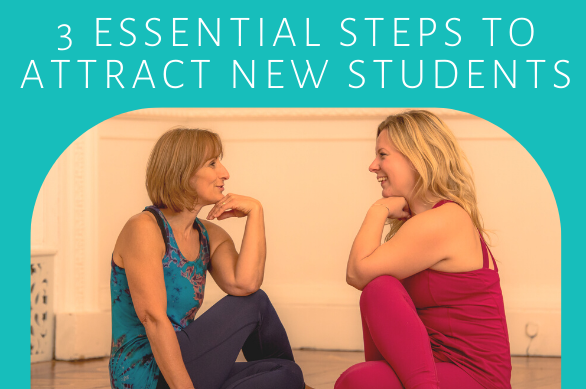
3 Essential Steps to Attract New Students to your Yoga Classes

Marketing for Yoga Teachers

Every Yoga Teacher’s number 1 question when it comes to marketing . . . How do I attract new students to my yoga classes, yoga retreats or yoga workshops?

Everyone hopes that the next new marketing trend, social media platform or online course will provide the magic formula for you to fill your yoga classes. BUT, that’s just not how it works – SORRY! You’re the one being marketed to, sold to when you buy into the hype about the next latest craze.

Attracting new students to your yoga classes has got nothing to do with reels, ticktock or facebook ads but the principles behind marketing and understanding buying psychology.  

There are many ways of putting our yoga class offerings in front of potential yoga students, from good old fashioned posters, flyering, attending local groups, having stalls at local fairs and community outreach, to the online world of Facebook group, ads, Instagram, YouTube etc but your marketing won’t work if you don’t understand and implement the 3  essential steps to attracting new students below.

It all comes down to Know, Like & Trust

Now in the world of marketing, this is a very clichéd term. A cliché is a phrase that has been used so many times that it loses its impact but that doesn’t make it any less true. There is a reason this phrase is said so often and that’s because it’s true.  People will only ‘buy’ from you when they Know, Like & Trust you!

But rarely do business owners actually stop and analyse their marketing right from their websites and social media down to posters and flyers – what decisions are you making that consciously cultivate the Know, Like & Trust factor?

Start with You

So think about you – what does it take for you to feel like you Know, Like & Trust someone.  Stop reading this blog for a moment and really ask yourself this. When you meet someone new, what does it take for you to feel like you Know, Like & Trust them.

Now let’s explore this a little more:

To Know You

It is going to take time for someone to get to know you.  You need to spend time cultivating relationships with people. You can’t just stick up one social media post a month, 1 flyer a year and expect new students to take action. Simple things that are essential to let someone get to know you.

Laura Green Yoga
Hi, I’m Laura!
  • Your Name – how can I feel like I know you if I don’t know your name? Especially if you’re using a ‘brand name’ for your yoga business, please make sure your actual name is visible everywhere.
  • Your Face – if I don’t know what you look like, how can I recognise you? If I can’t recognise you, I don’t know you. Stop using stock photography, stop hiding your face in your pictures. On your posters, social, website, flyers, put a photo of you with your face clearly visible. Smile and let me see your eyes. Let me see you!
  • Your Voice – when you can recognise someone just from their voice you feel like you really know them. Now, this might be your spoken voice – in videos on your website, your social or just your tone of voice in your writing. I write like I speak, you can hear that here now – me, Laura, I’m writing talking to you!

To Like You

When you like someone it’s usually because you see something of you in them or you have a shared connection, interest, values or mission. To bond with someone, you have to open up and share a little about yourself. Let me know you. What are your interests, do you have any pets, what are you passionate about?

Now you don’t have to share everything about you. Boundaries are important (see my related posted on Boundaries for Yoga Teachers) so I recommend picking 3 topics that you’re passionate about that you share regularly and consistently. I share my passions for Cats, Travel and my Music (I’m a harpist). If you ask anyone about me, they’ll say, yoga teacher, crazy cat person, goes on amazing adventures and loves music. A great way to do this is through lifestyle photos, videos and sharing other posts from social media accounts that you follow personally.

Laura Green Yoga
This is me playing my Harp at a wedding – feel like you’re getting to know me?

To Trust You

Again this can take time, but an easy way to speed up the process is to help someone. If you go out of your way to help someone they instantly feel like they can trust you. Make time for people, answer questions, respond to all comments on your social posts, be available to people, be open. Make it easy for people to open up and talk to you. Invite questions, have your phone number easily displayed. And demonstrate your knowledge to build credibility. Share educational videos, blog posts. Top tips.

This can all be summed up as:

To attract new students build real relationship with real people focusing on the know, like and trust.

This takes time, there is no quick fix.

1 student at a time to build a sustainable business. It’s simple but requires consistent effort!


Facebook

How to nurture your Yoga Business in harmony with the Chakras

Marketing to Yoga Teachers

Your yoga business is not simply a way to put food on the table – it’s your calling to reach out to the lives of many; to bring real, tangible benefits to all areas of their lives.

Your yoga business has “doing good” as its central mission; physical health and spiritual growth at its very core – just like yoga practice itself.

A business led by the heart can certainly bring you emotional, spiritual and financial fulfilment. There’s no better way to facilitate that than by linking the spiritual aspects of yogic teachings with the day-to-day of running your business.

Connect the spirit of you and your business through the psychology of the Chakras

Root Chakra

❤️ Foundation – who are you, what do you know, what are you qualified to teach, what is your area of expertise. Get clear on these – lean into radical authenticity. These questions will bring you to your central mission statement and help all of your principles and values align. When you get clear on this part, you attract the clients who will adore what you have to give.

Sacral Chakra

🧡Create – craft your offerings – services, classes, content – that align with your gifts and the needs of your ideal client. This is why your business was born. You have gifts to share and the offerings you create are their vehicle into the world. Create freely, joyfully, and see your ideal clients respond in kind. 

Solar Plexus Chakra

💛 Courage – take action, commit to one of your offerings and create a clear step by step plan to put it into action. You don’t have to do it all at once. But you do have to do it! Your mission is to do good in this world, and your business is one of the ways you’ll do it. Don’t hide your light – take courage, be brave and put something out there. And if it scares you? Do it anyway!

Heart Chakra

💚 Passion – look back at your plans, your vision – do they still fill your heart with joy? Do they still speak to the person you are today? Share your passion, invite others to get excited about and invested in your shared vision. Together we can change the world.

Throat Chakra

💙 Communicate – build relationships, write about your offerings, share your voice in videos, podcasts. Talk to everyone and anyone about your work. Invite people to experience it for themselves. Start conversations. Communication is your key to sharing the joy of what you do.

Third Eye Chakra

💜 Wisdom – look back over your journey with the wise eye of self-study. Have the wisdom to be totally honest with yourself. What do you do wonderfully? Which areas need to develop? Tweak things, adjust, evolve your work. You owe it to yourself, your business, and your clients.

Crown Chakra

🤍 Trust – when you walk your path, when you take action and when you show up for your dreams – you are not alone. Trust in yourself, trust in your business, trust in your gifts and your offerings. And trust that the universe will show up for you when you show up in service.

Have you extended your knowledge and practice of the Chakras to your business life?

For more Yoga Teacher Support and Mentoring, connect with Laura about a 1:1 90 Min Coaching Call.


Facebook

Plan Your Yoga Business with the Moon’s Phases – Moon Business Planner

Moon Business Planner

Ever thought about having a Moon Business Planner for your Yoga Business? As a Yoga Teacher, how do you create plans and strategies for your yoga business?

My guess is you probably don’t! After all, as Yoga Teachers, our passion is yoga and that’s where we focus our attention. Lesson planning, creating sequences, connecting with our students and guiding yoga. I bet you didn’t get into Teaching Yoga to create marketing plans and business strategies! But . . .

You do need to attract new yoga students to share your passion for yoga with! You do need to create yoga offerings be theses class, workshops, retreats and you do need a plan for how to market these offerings and this my loves is what a business planning is all about!

Having strategic plans for your yoga business is also a great way to avoid overwhelm as you know what you’re doing and when. Good business takes patience and consistency a plan keep you on track with this!

I love to live in harmony with the moon’s phases and plan to harness the moon’s energy by using my Moon Phase Business Planner. As we all know, everything is cyclical and working in alignment with the moon can really help sustain energy and momentum in your business.

Think of it like the Moons Phases:

New Moon

Draw in, reflect and daydream about new ideas/offerings/growth in your business.

Waxing Moon

Take action behind the scenes, plan out the content, write your marketing, create your graphics, prepare your lesson plans, update your website.

Full Moon

It’s time to shine, launch your classes/workshops. Be really visible on social media, do your IG and Facebook Lives. Let the brilliance of the moon illuminate your offering.

Waning Moon

Drawback from public view a little and focus on your actual clients, give them your focus and delight them with your offerings.

Download Your FREE Moon Business Planner

Get started today with this free downloadable Moon Business Planner and start to harness the power of the moon to illuminate your yoga teachings.

For more FREE support and trainings to Thrive as a yoga teacher, come join The Yoga Teacher Collaborative Facebook Group, there’s a free video training every single Friday.


Facebook